Phocoena sinus · vaquita · “little cow”
The world’s most endangered marine mammal always looks like it’s smiling.
Dark rings circle its eyes and its lips curve up at the corners, but the vaquita has little to smile about. The world’s smallest porpoise lives only in one corner of Mexico’s Gulf of California, where fishing nets have drowned so many that the 2025 survey saw only seven to ten.
The species
The vaquita is the smallest porpoise alive and one of the smallest cetaceans (whales, porpoises, dolphins) of any kind. A full-grown female is up to about 1.5 metres long, roughly the height of a 12-year-old, and weighs about as much as a large dog (somewhere between a Labrador and a Great Dane, or 30 to 55 kilograms).
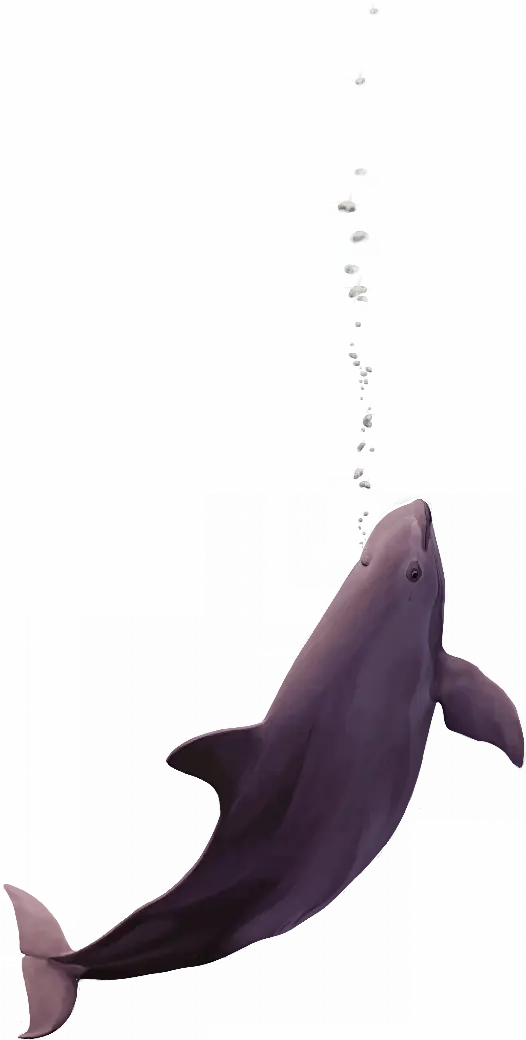
Plenty of porpoises have striking markings (the spectacled porpoise is a good example), but the vaquita’s face is its own. Dark patches ring its eyes like an eyepatch, and a dark line runs along its lips, which gives it a face you won’t mix up with any other.
They are shy, they surface briefly and quietly, and they have never been kept alive in captivity. There are photos of living vaquitas, but they’re taken from a distance as the animals briefly surface, and most close-ups are of stranded, dead animals. Nobody has the sharp photos or video that exist for, say, killer whales. The illustrations on this page are drawn from the few good pictures there are.

- 1.5 m the longest adult females, nose to tail
- ~ 20 years, the estimated maximum lifespan
7–10
different vaquitas seen during the 2025 survey, including at least one calf. This is a count of the animals observers saw in a small search area, so it is not a population estimate. The whole range was last surveyed in 2015, and the last estimate of the total population was for 2018.
CONANP · 2025 survey
reviewed · source: CONANP · 2025 survey (opens in a new tab)
The vaquita’s home is tiny
The vaquita has never been recorded anywhere but the northern end of the Gulf of California. Since 2017, most of the ones anyone has seen or heard were in one small patch of that water, and recent surveys keep finding a few just outside it.
Skip the map sequence ↓- Historical range
- Biosphere reserve
- Gillnet ban
- Vaquita Refuge
- Zero Tolerance Area
- 2026 drafts
-
1 of 5 · The eastern Pacific
The vaquita lives in a very small part of a very large ocean.
This view covers about a quarter of the planet. The vaquita is found in one corner of it and nowhere else.
-
2 of 5 · The Gulf of California
The Gulf of California runs about 1,200 kilometres between Baja California and mainland Mexico.
Whales, dolphins and sea lions live along its length. The vaquita lives only at its northern end.
-
3 of 5 · The historical range
Every vaquita ever recorded has lived inside this area.
NOAA maps the historical range at about 8,408 km², from the 2022 IUCN assessment, which is roughly the size of Puerto Rico. The dots are records from Mexico’s national biodiversity database, dated 1960 to 2008 where a date is given. They show where vaquitas were found then, not where they are now.
-
4 of 5 · The protected areas
Mexico has drawn three boundaries through this water.
The long dashed outline is the area where gillnets are banned. Inside it is the Vaquita Refuge, 1,841 km² since its 2018 enlargement and about the size of Greater London. The fine dotted line is the biosphere reserve, shown for context rather than as a vaquita boundary.
-
5 of 5 · The Zero Tolerance Area
Enforcement is strictest inside this 225 km² box.
Mexico decreed it in 2020, and most vaquita detections since 2017 have come from inside it. The thin dashed lines are replacement boundaries drafted in 2026 and not yet enacted. Recent surveys have also found vaquitas outside the box, and in September 2025 CONANP heard them as far out as the refuge boundary.
Making sense of the numbers
-
Most detections come from a tiny sliver of the Gulf
The Gulf of California covers somewhere between 160,000 km² and 177,000 km² of water, depending on the source. Most detections since 2017 fall inside 225 km² of it, which is less than a sixth of one percent.
-
The water the vaquita relies on most is a short stretch of sea
The Zero Tolerance Area is a tilted box about 22 km along its top edge and 10 km down its side. Were it road instead of sea, you could drive the length of it before your coffee went cold.
-
The vaquita’s world gets smaller at every step
The vaquita’s whole known range, 8,408 km², is about the size of Puerto Rico. The refuge inside it, 1,841 km², is a little larger than Greater London. The area where most of them are still heard, 225 km², is less than half the size of Lake Tahoe.
The same facts, without the map
- The vaquita is found only in the northern end of the Gulf of California, Mexico. It has never been recorded anywhere else.
- NOAA’s historical-range polygon, referenced to the 2022 IUCN assessment, covers about 8,408 km². NOAA’s prose estimate is smaller again, at roughly 3,934 km² east of San Felipe. They are different products and should not be added together.
- Three enacted Mexican boundaries overlap that water: the Vaquita Refuge Area (1,841 km², DOF 2018), the Zero Tolerance Area (225 km², DOF 2020) and the much larger gillnet-prohibition area (2020). “Exclusion area” on its own does not identify any one of them.
- The IUCN’s 2022 Red List assessment found that nearly all detections since 2018 had been inside the Zero Tolerance Area. Surveys since then have found vaquitas outside it. Half the 2024 sightings were in the area just beyond its edge, and in 2025 a fifth of the sightings were outside the area the concrete blocks protect, with acoustic detections (93 encounters at 24 of 66 sites in September) reaching the edge of the Vaquita Refuge.
- A replacement gillnet exclusion area, special use area and transit channel were drafted in 2026. As of 29 July 2026 no DOF publication had enacted them.
- The dots on the map are CONABIO/SNIB occurrence records: 430 exported records at 256 distinct locations. The 322 that carry a date run from 1960 to 2008. They are historical collection and observation records, so they show neither living animals nor a habitat boundary.
- The nearest ports are San Felipe, Golfo de Santa Clara and Puerto Peñasco.
Every boundary drawn here comes from its own published coordinate table, transformed to WGS 84 (DOF 2018 and 2020, CIRVA-13, NOAA Fisheries, CONANP). Areas quoted are the figures each instrument states; recomputing them from the published vertices gives values within a few percent. Not for legal or enforcement use.
The threat
One thing kills vaquitas: gillnets. A gillnet is a wall of fine mesh hung in the water column, invisible to a porpoise using echolocation the way a pane of glass is invisible to a bird. They swim into it, they cannot surface, and they drown.
Most of the nets in the vaquita’s range are set illegally for totoaba, a large fish whose dried swim bladder sells for extraordinary sums in an overseas market. Nobody has ever fished for the vaquita itself, and every one caught in a net is bycatch.
The cause is a trafficking market and enforcement that has not held. The fishing communities of the Upper Gulf have lived with a shrinking legal livelihood and a violent illegal trade operating alongside it.
- 1 cause of death that matters — entanglement in gillnets IUCN SSC CSG
- 2015 the last year anyone surveyed the whole range IUCN SSC CSG
- 7–10 vaquitas seen on the 2025 survey, including at least one calf. A minimum count from a small search area. CONANP · 2025
The timeline
It took thirty-four million years of toothed whales branching apart to arrive at this animal. People have known it exists for seventy-six of those years, and in that time it went from a skull on a beach to the seven to ten animals the 2025 survey managed to see.
The story has two halves that move at very different speeds. Pick any marker to read what happened and where the figure comes from.Every card carries the study or the law it came from.
- ~2.4m years the vaquita has been its own species (somewhere between 1.7 and 3.2 million) Ben Chehida et al. 2020
- 76 years since the first vaquita was found, in 1950
- 98% fewer vaquitas in 2018 than in 1997. Whole-population estimates fell from about 567 to about 9 in 21 years. Jaramillo-Legorreta et al. 1999 · 2019
Act one · deep time
The vaquita has been a small population for about 300,000 years.
Each mark is a branching point in the family tree, dated from DNA and fossils. The scale is squeezed, so each step to the left covers more time.
What’s the shaded part?
The shaded stretch is the last 150 years. To fit 34 million years on one line, this scale is squeezed, so the further left you go, the more time each step covers. On an even scale, those 150 years would be thinner than a hair. Act two, below, zooms into them.
-
34 million years ago
Toothed whales begin to diversify
The lineage that leads to every dolphin, porpoise and sperm whale alive starts splitting apart. Nothing that looks like a porpoise exists yet — this is simply how far back the family goes.
A model estimate from DNA, calibrated against fossils. It is not an observed date.
Source: Toothed whales begin to diversify
McGowen et al. 2020 · Systematic Biology 69:479–501
Cetacean tree of life from more than 38,000 nuclear exons, dated against fossil calibrations.
Open the source: McGowen et al. 2020 · Systematic Biology 69:479–501 (opens in a new tab) -
~19.8 million years ago
Dolphins and porpoises part company
At the root of the group, oceanic dolphins split from the branch that will later divide into porpoises and the beluga–narwhal line. Everything after this is porpoise prehistory.
95% interval 18.8–20.8 million years. Porpoises as a family did not exist yet at this point.
Source: Dolphins and porpoises part company
McGowen et al. 2020 · Systematic Biology 69:479–501
Cetacean tree of life from more than 38,000 nuclear exons, dated against fossil calibrations.
Open the source: McGowen et al. 2020 · Systematic Biology 69:479–501 (opens in a new tab) -
~11.4 million years ago
The porpoise family begins
The porpoise branch separates from the one carrying beluga and narwhal. The study anchored this date partly on Salumiphocaena, a fossil porpoise from California about 10 to 11 million years old, which it treated as the oldest known.
95% interval 10.0–14.0 million years; estimates differ between studies.
Source: The porpoise family begins
Chen et al. 2011 · BMC Evolutionary Biology 11:314
Divergence dated from retroposed genetic elements and their flanking sequences.
Open the source: Chen et al. 2011 · BMC Evolutionary Biology 11:314 (opens in a new tab) -
~5.4 million years ago
The seven living porpoises trace back to this point
The first split inside the modern family. Everything from the finless porpoises of Asian coasts and the Yangtze to the vaquita in the Gulf of California descends from this one ancestor.
95% interval 4.2–6.9 million years. Dated from mitochondrial DNA; a nuclear family tree can differ.
Source: The seven living porpoises trace back to this point
Ben Chehida et al. 2020 · Scientific Reports 10:15190
71 complete mitochondrial genomes covering every living porpoise species; supplies most of the dates on this axis, with 95% intervals.
Open the source: Ben Chehida et al. 2020 · Scientific Reports 10:15190 (opens in a new tab) -
~2.4 million years ago
The vaquita branch splits off
Its line separates from the ancestor of two southern porpoises, the spectacled and Burmeister’s. The authors’ most likely explanation is that colder water during an ice age let an ancestor from the south cross the equator, and its descendants stayed isolated in the north.
95% interval 1.7–3.2 million years. A lineage split is a proxy for becoming a species, not an exact moment.
Source: The vaquita branch splits off
Ben Chehida et al. 2020 · Scientific Reports 10:15190
71 complete mitochondrial genomes covering every living porpoise species; supplies most of the dates on this axis, with 95% intervals.
Open the source: Ben Chehida et al. 2020 · Scientific Reports 10:15190 (opens in a new tab) -
~300,000 years ago
Cut off in the Gulf of California
The genome shows a population that has stayed small since about this time. The study’s authors think a warming climate at the end of an ice age left it cut off in the newly expanded, shallow upper Gulf, where it has lived ever since.
The genome shows a small population for about the last 300,000 years. The isolation is the authors’ hypothesis, which they tie to the end of an ice age about 130,000 years ago.
Source: Cut off in the Gulf of California
Morin et al. 2021 · Molecular Ecology Resources 21:1008–1020
The vaquita reference genome, and the population history read back out of it.
Open the source: Morin et al. 2021 · Molecular Ecology Resources 21:1008–1020 (opens in a new tab) -
~315,000 years ago
Homo sapiens appears, at almost the same moment
The oldest fossils of our own species come from Jebel Irhoud in Morocco, dated to roughly 315,000 years ago. Within the resolution of these dates, the vaquita’s long run as a small population was beginning at about the time we were becoming ourselves. The two lines have run in parallel ever since.
Fossil date, ±34,000 years. Species origins are gradual; this is the oldest evidence, not a birthday.
Source: Homo sapiens appears, at almost the same moment
Hublin et al. 2017 · Nature 546:289–292
Jebel Irhoud, Morocco: the oldest fossils yet attributed to Homo sapiens, dated to about 315,000 years ago.
Open the source: Hublin et al. 2017 · Nature 546:289–292 (opens in a new tab) -
~25,700 years ago
Around 2,800 breeding animals
Long before people arrived, the vaquita was already rare. About 25,700 years ago its breeding population fell from about 4,500 to about 2,800, and it has stayed small since. That turns out to be good news — it carries far less damaging inbreeding than a recently-crashed species would.
Estimate 2,807, 95% CI 1,832–3,982. This is effective population size, a genetic measure of breeders that is always smaller than a headcount.
Source: Around 2,800 breeding animals
Robinson et al. 2022 · Science 376:635–639
Whole genomes of 20 vaquitas, with simulations of what happens next.
Open the source: Robinson et al. 2022 · Science 376:635–639 (opens in a new tab) -
1950 and 1958
A skull on a beach near San Felipe
Kenneth Norris picked up a skull on a beach near San Felipe in March 1950. Eight years later he and William McFarland described it as a species no one had recorded before: Phocoena sinus, the vaquita.
This is when science met the animal.
Source: A skull on a beach near San Felipe
Norris & McFarland 1958 · Journal of Mammalogy 39:22–39
The original species description, written from three skulls.
Open the source: Norris & McFarland 1958 · Journal of Mammalogy 39:22–39 (opens in a new tab)
Act two · since we met it
It took us less than one lifetime to bring it to the edge of extinction.
The line shows the population falling from about 5,000 in 1920 to the handful seen in 2025. The markers under it are the laws enacted and rescue efforts undertaken. Most actions were only taken after the collapse of the population.
What the marks mean
- Whole-population estimate
- Minimum individuals seen — a different measurement
- Law or protected area
- Status change or alert
- Science and surveys
-
1920
About 5,000 vaquitas
5,015 Whole-population estimate
No one was counting in 1920. This figure comes from a population model worked backwards from later data — the best available picture of the species before industrial gillnets reached the Upper Gulf.
The median of a model reconstruction (Jaramillo-Legorreta 2008), not a survey. No range is published with it.
Source: About 5,000 vaquitas
Gerrodette & Rojas-Bracho 2011 · Marine Mammal Science 27:E101–E125
Reports the 1920 baseline (a median of 5,015 from Jaramillo-Legorreta’s 2008 population model, p.E120) and models the population from 1993 on.
Open the source: Gerrodette & Rojas-Bracho 2011 · Marine Mammal Science 27:E101–E125 (opens in a new tab) -
Science
18 March 1950
A skull on the shore of Punta San Felipe
Kenneth Norris found a vaquita skull on the north-east shore of Punta San Felipe. It became the specimen the species was described from.
Source: A skull on the shore of Punta San Felipe
Norris & McFarland 1958 · Journal of Mammalogy 39:22–39
The original species description, written from three skulls.
Open the source: Norris & McFarland 1958 · Journal of Mammalogy 39:22–39 (opens in a new tab) -
Science
February 1958
Phocoena sinus enters the record
Norris and McFarland described the animal from three skulls. Nobody had yet seen a living one.
Source: Phocoena sinus enters the record
Norris & McFarland 1958 · Journal of Mammalogy 39:22–39
The original species description, written from three skulls.
Open the source: Norris & McFarland 1958 · Journal of Mammalogy 39:22–39 (opens in a new tab) -
Science
1961
The first mention of bycatch
Three years after being named, the species is already being reported as accidental catch in local fisheries.
Source: The first mention of bycatch
Würsig, Jefferson, Silber & Wells 2021 · THERYA 12:187–206
Research history of the species, including the first recognition of fishery deaths.
Open the source: Würsig, Jefferson, Silber & Wells 2021 · THERYA 12:187–206 (opens in a new tab) -
Law
1 August 1975
Mexico closes the totoaba fishery
The fishery had already collapsed. Totoaba nets were the biggest killer of vaquitas — and the illegal version of that fishery is still the biggest killer today.
Source: Mexico closes the totoaba fishery
Diario Oficial de la Federación · 1 August 1975
The permanent closed season for totoaba, after that fishery collapsed.
Open the source: Diario Oficial de la Federación · 1 August 1975 (opens in a new tab) -
Status
28 June 1979
Highest international trade protection
Twenty-one years after being named, the vaquita is in the strictest category the trade convention has.
Source: Highest international trade protection
CITES · Appendix I listing history
Phocoena sinus entered Appendix I, the strictest trade category, on 28 June 1979.
Open the source: CITES · Appendix I listing history (opens in a new tab) -
Status
9 January 1985
Listed under the US Endangered Species Act
Listed under the name then used for it, the cochito. Effective 8 February 1985.
Source: Listed under the US Endangered Species Act
US Federal Register 50 FR 1056 · 9 January 1985
The Endangered Species Act listing, effective 8 February 1985.
Open the source: US Federal Register 50 FR 1056 · 9 January 1985 (opens in a new tab) -
Status
1986
First IUCN assessment
The species enters the Red List as Vulnerable, the lowest of the three threatened categories. By 1990 it is listed as Endangered.
Source: First IUCN assessment
Rojas-Bracho, Taylor & Jaramillo-Legorreta 2022 · IUCN Red List e.T17028A214541137
The current Red List assessment, with the status history: Vulnerable 1986 and 1988, Endangered 1990 and 1994, Critically Endangered since 1996.
Open the source: Rojas-Bracho, Taylor & Jaramillo-Legorreta 2022 · IUCN Red List e.T17028A214541137 (opens in a new tab) -
Law
10 June 1993
Upper Gulf biosphere reserve
Mexico protects the region and bans capture of vaquita and totoaba inside it, indefinitely.
Source: Upper Gulf biosphere reserve
Diario Oficial de la Federación · 10 June 1993
Creates the Upper Gulf biosphere reserve and bans capture of vaquita and totoaba inside it.
Open the source: Diario Oficial de la Federación · 10 June 1993 (opens in a new tab) -
Status
1996
One step from extinct in the wild
Ten years after the first assessment, the vaquita is moved to the highest risk category, where it has stayed ever since.
Source: One step from extinct in the wild
Rojas-Bracho, Taylor & Jaramillo-Legorreta 2022 · IUCN Red List e.T17028A214541137
The current Red List assessment, with the status history: Vulnerable 1986 and 1988, Endangered 1990 and 1994, Critically Endangered since 1996.
Open the source: Rojas-Bracho, Taylor & Jaramillo-Legorreta 2022 · IUCN Red List e.T17028A214541137 (opens in a new tab) -
1997
567 vaquitas — the first real count
567 Whole-population estimate
Three vessels, purpose-built survey design, the entire known range. This is the number every later estimate is measured against, and the last time the species could be described in hundreds.
95% CI 177–1,073. The bar shows that range.
Source: 567 vaquitas — the first real count
Jaramillo-Legorreta, Rojas-Bracho & Gerrodette 1999 · Marine Mammal Science 15:957–973
The 1997 three-vessel survey: 567 animals, 95% CI 177–1,073. The modern baseline.
Open the source: Jaramillo-Legorreta, Rojas-Bracho & Gerrodette 1999 · Marine Mammal Science 15:957–973 (opens in a new tab) -
Science
1997
Mexico and the US count the whole range
Three vessels, the entire known range, 567 animals. Every number since is compared with this one.
Source: Mexico and the US count the whole range
Jaramillo-Legorreta, Rojas-Bracho & Gerrodette 1999 · Marine Mammal Science 15:957–973
The 1997 three-vessel survey: 567 animals, 95% CI 177–1,073. The modern baseline.
Open the source: Jaramillo-Legorreta, Rojas-Bracho & Gerrodette 1999 · Marine Mammal Science 15:957–973 (opens in a new tab) -
Law
8 September 2005
A refuge in the western Upper Gulf
The first protected area drawn around the vaquita itself rather than the region. It was enlarged in 2018.
Source: A refuge in the western Upper Gulf
PACE-Vaquita · CONANP
Mexico's species action program, covering the 2005 refuge and the gear-conversion measures.
Open the source: PACE-Vaquita · CONANP (opens in a new tab) -
2008
245 left
245 Whole-population estimate
Eleven years later, a survey that watched and listened together found well under half as many.
95% CI 68–884. Wide, but the direction is not in doubt.
Source: 245 left
Gerrodette et al. 2011 · Marine Mammal Science 27:E79–E100
The 2008 survey combined watching and listening: 245 animals, 95% CI 68–884.
Open the source: Gerrodette et al. 2011 · Marine Mammal Science 27:E79–E100 (opens in a new tab) -
2015
About 100 — and this is the last full survey
100 Whole-population estimate
Published first as roughly 60, later revised upward to about 100 once animals seen alive in 2017 and 2018 were taken into account. No one has surveyed the whole range since.
Posterior mean 100, median 93, 95% CrI 47–191. Supersedes the original estimate of about 60 (median 59, 95% CrI 22–145).
Source: About 100 — and this is the last full survey
Jaramillo-Legorreta et al. 2019 · Royal Society Open Science 6:190598
Revises the 2015 estimate upward and gives the last whole-population figure, for 2018.
Open the source: Jaramillo-Legorreta et al. 2019 · Royal Society Open Science 6:190598 (opens in a new tab) -
Law
10 April 2015
Two years, no gillnets
An emergency suspension across a large polygon of the northern Gulf, paired with compensation for fishers. The population kept falling while it was in force.
Source: Two years, no gillnets
Diario Oficial de la Federación · 10 April 2015
The two-year emergency suspension of gillnets across a large part of the northern Gulf.
Open the source: Diario Oficial de la Federación · 10 April 2015 (opens in a new tab) -
2016
About 30
33 Whole-population estimate
Projected forward from the 2015 survey using acoustic detection rates, which fell by about half (a mean of 49%) between 2015 and 2016.
Mean 33, median 27, 95% CrI 8–96. A projection from acoustics, not a new survey, made from the original 2015 estimate of about 60 before it was revised to about 100.
Source: About 30
Thomas et al. 2017 · JASA 142:EL512–EL517
Acoustic detection rates projected forward from the 2015 estimate.
Open the source: Thomas et al. 2017 · JASA 142:EL512–EL517 (opens in a new tab) -
Law
30 June 2017
The ban is made permanent
Mexico permanently prohibits gillnets for small vessels in the northern Gulf. Since then, the problem has been enforcing it.
Source: The ban is made permanent
Diario Oficial de la Federación · 30 June 2017
Makes the gillnet prohibition permanent, with landing-site and vessel rules.
Open the source: Diario Oficial de la Federación · 30 June 2017 (opens in a new tab) -
Science
October–November 2017
VaquitaCPR stops after a death
An international team tried to hold vaquitas safely in human care. The first animal was released within hours; the second, an adult female, died. Captures were suspended and will not be tried again.
Source: VaquitaCPR stops after a death
Rojas-Bracho et al. 2019 · Endangered Species Research 38:11–27
The VaquitaCPR field effort, written up by the team that ran it.
Open the source: Rojas-Bracho et al. 2019 · Endangered Species Research 38:11–27 (opens in a new tab) -
2018
Nine
9 Whole-population estimate
The last formal whole-population estimate anyone has published, made eight years ago.
Mean 9, median 8, 95% CrI 6–19.
Source: Nine
Jaramillo-Legorreta et al. 2019 · Royal Society Open Science 6:190598
Revises the 2015 estimate upward and gives the last whole-population figure, for 2018.
Open the source: Jaramillo-Legorreta et al. 2019 · Royal Society Open Science 6:190598 (opens in a new tab) -
2019
7 to 15 individuals seen
7–15 Minimum individuals seen — a different measurement
From here the record changes shape. Instead of estimating a population, surveys count how many different animals they can positively identify in a small search area. The experts judged three calves the most likely number among them.
Plausible range 7–15, most likely about 11; 84% belief of 9–13. Minimum unique individuals seen in the survey area, not a population estimate; the two series are different measurements.
Source: 7 to 15 individuals seen
Rojas-Bracho et al. 2022 · Endangered Species Research 48:225–234
Expert elicitation from the 2019 and 2021 surveys: minimum individuals seen, not a population estimate.
Open the source: Rojas-Bracho et al. 2022 · Endangered Species Research 48:225–234 (opens in a new tab) -
Law
24 September 2020
A no-fishing core, in law
A 225 km² box where no fishing of any kind is allowed, inside the wider prohibition area. Most detections since have been inside it or just beyond its edges.
Source: A no-fishing core, in law
Diario Oficial de la Federación · 24 September 2020
Creates the Zero Tolerance Area and the wider gillnet prohibition area in law.
Open the source: Diario Oficial de la Federación · 24 September 2020 (opens in a new tab) -
2021
5 to 13 individuals seen
5–13 Minimum individuals seen — a different measurement
Healthy animals, calves again, in the same small core area — under continuing gillnet pressure.
Plausible range 5–13, with 7 and 8 judged equally most likely; 78% belief of 6–10. Minimum seen, not a population estimate.
Source: 5 to 13 individuals seen
Rojas-Bracho et al. 2022 · Endangered Species Research 48:225–234
Expert elicitation from the 2019 and 2021 surveys: minimum individuals seen, not a population estimate.
Open the source: Rojas-Bracho et al. 2022 · Endangered Species Research 48:225–234 (opens in a new tab) -
Law
July–October 2022
193 hooked blocks on the seabed
The Navy laid a grid of concrete blocks designed to snag illegal nets. 216 more followed in 2024, and vessel presence in the area dropped sharply.
Source: 193 hooked blocks on the seabed
Secretaría de Marina · 2022 concrete-block project
193 hooked concrete blocks laid on a one-kilometre grid to snag illegal nets.
Open the source: Secretaría de Marina · 2022 concrete-block project (opens in a new tab) -
2023
8 to 13 individuals seen
8–13 Minimum individuals seen — a different measurement
Sixteen sightings, 61 acoustic detections, one or two calves — and a sharp drop in illegal fishing inside the Zero Tolerance Area.
Mean 10.6; 76% probability of 8–13. The 2025 report’s harmonized comparison restates it as 67% probability of 8–12. Minimum seen in the study area.
Source: 8 to 13 individuals seen
Vaquita survey report 2023 · CONANP, NOAA and Sea Shepherd
61 acoustic detections and 16 sightings; expert elicitation put the observed minimum at 8–13.
Open the source: Vaquita survey report 2023 · CONANP, NOAA and Sea Shepherd (opens in a new tab) -
Status
7 August 2023
The IWC issues its first Extinction Alert
The International Whaling Commission had never issued one before. It named the vaquita and said replacing gillnets remains the only thing that will work.
Source: The IWC issues its first Extinction Alert
International Whaling Commission · 7 August 2023
The first Extinction Alert the IWC has ever issued.
Open the source: International Whaling Commission · 7 August 2023 (opens in a new tab) -
2024
6 to 8 individuals seen
6–8 Minimum individuals seen — a different measurement
Healthy animals including a juvenile, but no newborn confidently identified. Only about an eighth of the 2015 search area was covered.
Mean 7.62; 75% probability of 6–8. Explicitly not a whole-population count.
Source: 6 to 8 individuals seen
Informe del Crucero de Observación Vaquita 2025 · CONANP
The most recent survey, and the harmonized 2023–2025 comparison. Covers a small study area, not the whole range.
Open the source: Informe del Crucero de Observación Vaquita 2025 · CONANP (opens in a new tab) -
September 2025
7 to 10 individuals seen
7–10 Minimum individuals seen — a different measurement
One or two calves. Many detections came from north-west of the protected core — outside the box where enforcement is absolute.
Mean 8.52; 67% probability of 7–10. Minimum seen in the study area, not the total population.
Source: 7 to 10 individuals seen
Informe del Crucero de Observación Vaquita 2025 · CONANP
The most recent survey, and the harmonized 2023–2025 comparison. Covers a small study area, not the whole range.
Open the source: Informe del Crucero de Observación Vaquita 2025 · CONANP (opens in a new tab) -
Status
As of 30 July 2026
The next set of protections is not law yet
CIRVA has warned that the proposed replacement boundaries leave out shallow north-western water where vaquitas were detected in 2025. The 2020 agreement is still the operative instrument.
Research status as of 30 July 2026, not a government declaration.
Source: The next set of protections is not law yet
CIRVA-13 report · February and March 2026
The recovery committee's reading of the 2025 distribution data and the still-unenacted 2026 rules.
Open the source: CIRVA-13 report · February and March 2026 (opens in a new tab)
Linear scale. Population estimate · Animals identified in surveys (not comparable) · Bars: 95% intervals.
Can the vaquita recover, and how long would it take?
Suppose every gillnet came out of the Gulf of California tomorrow. The vaquita could recover, but vaquitas have very few young, so getting their numbers back would take somewhere between 70 and 100 years, and that clock only starts once the nets are gone.
How long it could take
Vaquitas have very few young. A female can first breed somewhere between three and six years old and has one calf at a time, and scientists aren’t sure whether she rests a year between calves or has one every year. That one unknown changes the answer by decades, so here are both.
-
If mothers rest a year between calves (what scientists have long thought) about 100 years · around 2130
-
If mothers have a calf every year (the most hopeful case) about 70 years · around 2095
2026 2056 2086 2116 2146
Either way it’s somewhere between seven and ten vaquita generations. A child born this year would be about 70, or over 100, before the vaquita was back to where it was in 1997.
What these estimates assume
- Every gillnet is gone this year, and no more vaquitas die in them.
- We start from about ten vaquitas, the top of the likely range from the 2025 survey.
- The population grows at the best-case rate scientists have published for vaquitas, every single year.
- Vaquitas still find each other to breed, even when there are very few of them.
- Nothing else goes wrong, like a heatwave, a disease or a year when food runs short.
Why the real answer is probably slower
Real life is messier than any estimate, and some of those things will go wrong. So treat these as the fastest the vaquita could come back. The Gulf will need protecting for decades after the first signs of recovery.
Can ten be enough?
Their genes are in better shape than you’d expect
When a species is down to a handful of animals, the usual worry is inbreeding. Closely related parents pass on hidden genetic faults, and calves don’t survive. Vaquitas have always been rare, though, and over tens of thousands of years most of those faults were weeded out. When scientists read the genomes of twenty vaquitas, they found very little hidden damage.
They then used those genomes to simulate the next fifty years many times over. If no more vaquitas die in nets, the vaquita survives in 94 of every 100 runs. If nets keep killing them, even at a fifth of the rate of recent years, the vaquita is more likely to disappear than survive.
Good genes don’t protect against everything. Heatwaves, food running short and a changing sea aren’t part of these models, and nobody has measured how they would affect the vaquita.
Frozen cells can’t bring them back
In 2017, scientists grew living cells from two female vaquitas and froze them at the Frozen Zoo in San Diego. Those cells are valuable for research, and they’re a big part of why we know so much about vaquita genetics.
They can’t replace the animals, though. Cloning a vaquita would need egg cells and a surrogate mother from a closely related species, no whale, dolphin or porpoise has ever been cloned, and no vaquita has ever survived in human care. Cells from two animals couldn’t rebuild a population anyway.
San Diego Zoo Wildlife Alliance · Frozen Zoo, 2018
None of this recovery can begin while gillnets are still in the water, so every year they stay adds another year to the wait.
Where these numbers come from
The growth rates are the published best cases: about 4% a year if mothers rest a year between calves, and roughly 6% if they have a calf every year (Jaramillo-Legorreta et al. 2019). A vaquita generation is about 10 years (IUCN 2022), and the breeding ages and calving intervals come from Hohn et al. 1996 and Taylor et al. 2019.
The estimates assume that best-case growth every single year, starting from ten animals: about 103 years to reach 567 at 4%, and about 69 at 6%. They are rounded to about 100 and about 70 because nobody can predict a population this precisely.
Hohn et al. 1996 · Journal of Zoology 239
Jaramillo-Legorreta et al. 1999 · Marine Mammal Science 15
Gerrodette & Rojas-Bracho 2011 · Marine Mammal Science 27
Jaramillo-Legorreta et al. 2019 · Royal Society Open Science 6
Robinson et al. 2022 · Science 376
Kyriazis et al. 2023 · Heredity 130
Taylor et al. 2019 · Marine Mammal Science 35
Rojas-Bracho, Taylor & Jaramillo-Legorreta 2022 · IUCN Red List
What’s being done to save the vaquita?
Mexico and scientists from around the world have been working to protect the vaquita for more than thirty years. Some of that work is now clearly helping the animals that are left, and some of it never stopped the nets.
Latest · 30 July 2026 Mexico’s new fishing rules are still a draft, and they leave a gap.
CIRVA, the international scientific committee that advises Mexico on saving the vaquita, says the draft leaves a stretch of shallow water to the north-west without concrete-block protection, even though vaquitas were seen and heard there in 2025.
What’s working
-
409 concrete blocks snag nets where the vaquitas live.
Mexico’s Navy has laid 409 hooked concrete blocks on the seabed where the last vaquitas live, 193 in 2022 and 216 more in 2024, and they catch any gillnet set there. CIRVA says the blocks are the only measure so far proven to protect vaquitas.
-
More than 90% fewer boats fish in the core area.
Fishers now mostly keep out of the Zero Tolerance Area, the 225 km² no-fishing zone set up in 2020. Sea Shepherd’s radar counted over 90% fewer boats there in each fishing season from 2023 to 2025, compared with before the blocks went in, with joint Navy patrols helping.
-
The vaquitas there look healthy, and they’re still having calves.
Surveys keep finding young vaquitas. In 2025, drone footage showed adults and young in good condition and feeding undisturbed, and a female the team calls Frida, known by her bent dorsal fin, had her second calf since 2023.
-
Underwater microphones hear vaquitas nobody can see.
Underwater detectors pick up vaquitas’ clicks when nobody can see them. They tracked the decline from 2011, and in 2024 and 2025 they showed vaquitas using water north-west of the protected core, which is why CIRVA wants that area protected too.
What hasn’t worked
-
Gillnet bans on paper didn’t keep the nets out of the water.
Mexico banned gillnets across the northern Gulf, for two years in 2015 and permanently in 2017, and the vaquita kept declining. Mexican officials told CIRVA in 2026 that the 2020 rules had been impossible to enforce, and on some days that January radar still picked up more than 40 boats possibly net fishing in the refuge.
-
The switch to safer fishing gear is still unfinished.
Since 2008, Mexico has offered fishers compensation and gear that doesn’t trap porpoises. According to NOAA this may have slowed the decline without stopping it, and CIRVA still lists the move to vaquita-safe gear as unfinished work.
-
Catching vaquitas to protect them ended when one died.
In 2017 an international team, VaquitaCPR, tried to move vaquitas into human care until the nets were gone. The first animal caught was so stressed she was released within hours, the second, an adult female, died, and captures will not be tried again.
-
Money from smuggled totoaba keeps the nets coming back.
The nets are set for totoaba, a large fish whose dried swim bladder is smuggled to China. NOAA reports a kilogram can pay a fisher about half a year’s legal income, and illegal fishing has carried on since Mexico closed the fishery in 1975.
What you can do
Become a vaquita supporter
You’ll hear what’s happening in the Gulf, and we’ll tell you when there’s a petition to sign or a letter to send.
- News from the Gulf, when there’s something worth telling you
- A heads-up when there’s a petition to sign or a letter to send
- The dates of the next Save The Vaquita Week
Stream for the vaquita
Give an hour of your channel during Save The Vaquita Week. Channels of any size and any kind of content are welcome.
Registration is closed for this year.
Donate
Your donation goes to the Porpoise Conservation Society (Porpoise.org), one of the members of ¡VIVA Vaquita!, a coalition of non-profit organizations from around the world working together to save the vaquita. DonateTell one person
Send this page to someone who hasn’t heard of the vaquita.